Showing posts with label linen. Show all posts

Saturday, 16 April 2011

Of the late 15th century Armourer's wife... 4

It's been a long long long time since i last posted... at least, it feels like it! Dissertation has had to take priority, but sewing a little in the evenings has kept my sanity. FINALLY i've got the green sleeves sewn and altered to fit on my green overdress, so i've got some piccies here:


I've tried to make them not so tight that i can't fit my lined underdress sleeves through. On the subject of underdress, already, the weight of the skirt has taken its toll on the close jump rings fastening the sides... I fear I may have to remove them and add braid/more material to strengthen the sides. before reattaching the rings, so that they don't rip the fabric! I may add some strips of red linen behind the openings, to avoid a draught... brrrr....

Next on the overdress is the hem; although i'm running a vague stitch through the seams of the lining and outer wool so that this is a lot easier! The dress as a whole requires ironing, something i've still failed thus far to do, so it must be done soon... mwahahahah!

Monday, 7 March 2011

Of the late 15th century Armourer's wife...

With the sudden event of engagement to an armourer and passionate re-enactor like myself, the requirement for late fifteenth century dress for shows (suiting that of the rising merchant/craftsmen class) has arisen, and so here is my research and progress thus far.
I require something that is practical and warm, though bits of decoration/flourish are allowed. 

   
The image above was my initial source of inspiration, dated at roughly 1465-8. I love the lady on the right hand side with her brocade sleeves and very clear waist seam with gathered skirt. The way her belt hangs casually and the combination of a stunning green with pale pink lining.  And again below, the 1470's lady at the feet of Christ shows a side laced gown with a gathered skirt waistline.


A lady below, again in green, has a similar waistline with little or no gathering but a full skirt. Note the way her belt equally hangs loose.


This woman below has been important, for unlike any garment i've made before, this outfit will have side lacing using metal closed rings and so this image has been increasingly valuable to help me understand how to do it.


With the aid of Mary G.Houston's 'Medieval Costume in England and France', i've decided to use one of her excellent pattern illustrations to try and shape my costume. Here are some initial sketches of what i hope to achieve, pattern-wise they do not necessarily follow what i have now, but they should give an idea:

Front and side:


Back:


The first sketch above has a 'frill' thing along the bottom of the underdress, which until now i assumed was extra flair to keep the skirt out. However i've been informed that it is actually extra skirt length pinned up on the outside, which makes sense! So now i no longer will have a frill; there never should have been one! I intend to make a silk partlet to sit on top or lie underneath the neckline to keep off the sun.

The Under Dress

Thus far the Squiggle has entirely hand sewn her bodice section - it needs the lacing finishing on the right hand side and decorative gold thread edging, but once the skirt is added, it will be complete!


As you can see, the lacing on the top edge will possibly require some stiffening such as braid or cord to prevent it from wrinkling. It is my hope that the tension of the removeable sleeves will also help keep it flat to the skin. If all else fails, the two flaps will be joined. 


Here is the back of my bodice, it has limited shape on a hanger, but once on me hopefully will make more sense.


Latest Development:


Skirt has been added to the bodice, just needs the bottom hemming, the inside seams tidying and the removable sleeves added! Quite happy with the front, very little alteration needed.

The back as I thought needs some taking in at the centre seam to fit round the shoulders, for it's quite tricky to do the back all by one Squiggle!


Saturday, 5 March 2011

Of the tortoise and the hare...

Yup, as per Squiggle usual, I'm up writing at an ever-so-student and insane hour. The time is 01:41am, the place is my cluttered room, littered with the haunts and shadows of an incomplete and uninspired degree dissertation. To those of my current course, this will be familiar and almost comforting to read! ;-)


Q. So what does a Squiggle do, when all energy has run its course and the once tearing stride of a hare grinds to a halt? When the well of academic ingenuity dries up? A. The Squiggle realises that perhaps the mistake was to be a hare in the first place. Secondly the Squiggle tries and fails to imitate a tortoise and simply ends up staring blankly at a screen for half an hour. In a third attempt, the Squiggle tries to return to something different that usually produces satisfying and confidence boosting results....


.... and so within minutes the Squiggle can be seen heaving her fifty year old sewing machine onto her desk and the room rapidly evolves into a swirling soup of red linen and pins! Yes, this was the moment for the meditative creation of a 15th century dress. I learnt the hard way over six years that to hare through a dress is not ideal if you still want to love the result two years later. So the two tortoise p's; patience and precision! With a lack of suitable costume fitting that of a medieval armourer's wife (to be able to do re-enactments with the fiancĂ©), I relished the opportunity to breach the gap between the simple Medieval patterns I have known for ages and the more tailored, Tudor styles that we are accustomed to today. Tailoring clothes to fit the female form was a growing feature in the fifteenth century, particularly in the later half - in fact just starting with a pre-tudor underdress has been a revelation experience in itself! It does not conform to casually quartering the measurements of garments; there are front panels, straps and side panels, not to mention the back panels! In fact it is more a test of mathematics and mental judgement than anything else which makes a vast contrast. We have more physical and artistic evidence for the construction of such garments, so thus i have less room to make guesses or self-inventions. Which leads me onto the subject that many women ponder:


Corsets. When did they start? How were they made, and why? In so far as we can tell, there was no use for them until clothes begin to fit in the fourteenth century onwards, though this is assumed, for we have no remaining evidence. And why should we? If they were purely functional, there should be no reason why they would last until today.
Be it a means of correcting posture, hiding a gluttonous diet or disguising the bodily dis-figuration from bearing so many children, there is little doubt that there must have been an origin to the advantageous Tudor 'bodiced look'. Some have suggested that strips of cloth may have bound stomachs, others have considered the use of whale bone, reeds and willow among other forms of support. In discussion with other costume enthusiasts, we have debated the use of feather or fish glue as a stiffener. This is not as ridiculous as it may appear; some Ancient Greek re-enactors have tried and tested fish glue to set layers of linen in order to form their body armour - and it works! However in attempting to re-create my own Medieval to Tudor transition garments, it has become apparent that it must have something to do with the placing of seams. A greater number of component segments results in many vertical seams, of which there are many seam edges with a chance of fraying. In providing enough material for future alteration and being able to 'double over' the edges at the back, they automatically produce a combined strength and stiff quality to the fabric, as well as ensuring that the garment lasts whole. Inside such seam folds, one might be able to insert an extra rod of some description. This is just a personal theory, and the general consensus seems to be that it most likely started as a whole dress with some minimal stiffening around the upper body, which went from there. I'm always trying to test the boundaries on this topic, so watch this space for many more crazy theories!


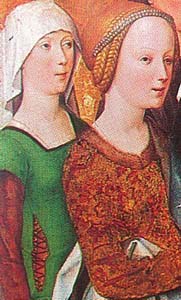
Thanks to Caroline for the following image of Maria Portinari, see how her dress has odd angles at the hips and the bodice of the girl behind her has a shape that only something stiff would achieve:


Because I have no wench-like bosom, any further support in my bodices risks only flattening myself further, so i shall settle this time for thick, flat seams. My current underdress has used about five-six metres of linen, for though it has a fitted top, the skirt is extremely full (photos to follow!) It already bears great weight, so it's becoming increasingly tricky to imagine the weight once i have a similar pink-linen-lined, green wool overdress on, with equal quantities of fabric! The neckline is Tudor square to suit the turn of the century, but it will have no hooped skirt, being based on some paintings from the time.


I considered hand sewing the entire thing, which i did for the bodice, but now the weighty Singer sewing machine is a true blessing.... Squiggle would have gone truly nuts without it! :-D