Feels like a loooooooooooooong time since the Squiggle last posted! She has been such a busy Squiggle!
Sam's sari maxi dress is nearing completion, it just needs the final tweaks and one last fitting...
Friend Harriet has requested a cotton, short summer dress, so we've found her some creamy broderie anglaise, cotton lawn and some Cath Kidston strawberry pattern fabric to be transformed. Next, the pattern! So a second session is require for the design to be finalised, the pattern formulated and the fabric cut.
A set of doll's clothes for friend Sandy has sat in a box recently waiting to be continued, so that's on this week's sewing lists...
My early fifteenth century, red wool overdress and red linen underdress needs to be completed within the next two weeks for a show, as does friend Alicia's outfit of blue cotton overdress, red linen underdress, cloak and headdress will all have to be created in this time too. Fortunately we have her speedy sewing machine to hand, so over-locking shouldn't be a problem. She is also a different shape body-wise to me, which poses new challenges....
Was there anything else?
Oh yes, and i need to pack to move house... this last weekend was spent hoovering dog-haired rug and carpet in my home-to-be.... Also i believe there is a presentation to sort for a week friday... hmmm....
Showing posts with label early fifteenth century. Show all posts
Showing posts with label early fifteenth century. Show all posts
Monday, 6 June 2011

Wednesday, 18 May 2011
Of a late fourteenth to early fifteenth century dress...
Good evening blog reader! :-) The Squiggle has been more industrious than ever...
So, with my late fifteenth century armourer's wife overgown nearing completion, now was the time to get moving on my slightly earlier, late fourteenth to early fifteenth century merchant dress, which is needed for other living history functions and wearing to an assessed lecture for my degree.
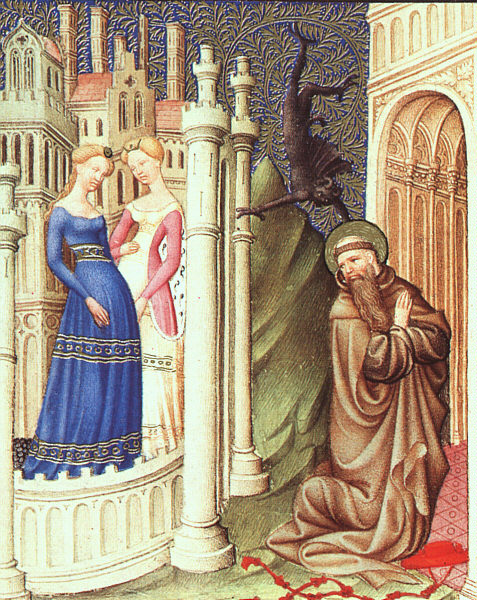
Let's show you a transition of styles in Europe, from slightly looser fitting gowns, through to the beginning of clothes tailoring as we know it now. You might notice that there is little differentiation between countries at this point, though the material itself becomes increasingly elaborate.


I've had to hand some of the softest. finest red wool (bottom left) i've ever beheld - one could mistake it for velvet! I've also had a subtle brocade in off-white/cream (right) and red linen (top left) to spare for lining:


The Herjolfsnes gown has been used frequently by re-enactors as a source for an original pattern. Its survival is one of only a pinch of resources. The 'gores' (aka panels) allow the gown to be adjusted to closely fit the body, thus achieving the tailored finish. The top left image is a rough pattern for the sleeve (the little triangle sits a little higher than the shoulder blade, rather than in the armpit where we normally put a diamond shaped insert for freedom of arm movement).
I plan to fasten it down the front with buttons or lacing and possibly have tippets (arm bands with long, dangly bits at the elbows) in white/cream. The fabric has been all cut and the front half of the wool tacked. With time so tight, i've resorted to sewing it together with my old hand-turn Singer machine, rather than hand stitching the whole lot! I'll wear my red linen underdress with the black and gold sleeves underneath....
Here are a few shots to give you an idea - better ones to come when more tacking comes out and i can model it! ;-) With the nature of its shape, it's impossible to lie completely flat out. My apologies for the strange colours - my camera wouldn't behave tonight under the room light....
Front body: Right hand side of dress has been machine sewn, left hand side to go, hence the more vague seams.The middle-centre seam has been tacked for the moment to allow me to alter the shape appropriately, but it will be released for lacing later.


Better photos and more progress to come! Watch this space! ;-D
So, with my late fifteenth century armourer's wife overgown nearing completion, now was the time to get moving on my slightly earlier, late fourteenth to early fifteenth century merchant dress, which is needed for other living history functions and wearing to an assessed lecture for my degree.
Let's show you a transition of styles in Europe, from slightly looser fitting gowns, through to the beginning of clothes tailoring as we know it now. You might notice that there is little differentiation between countries at this point, though the material itself becomes increasingly elaborate.
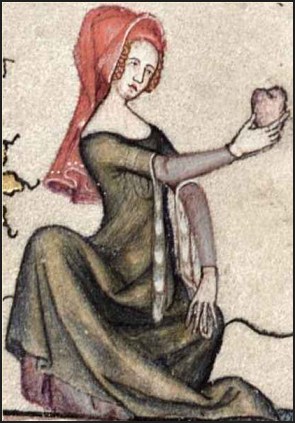
The Romance of Alexander, France, 1338-44
(I love the tapering end off the sleeves in this one!)

A marriage - a European Bride and her ladies, 1350's
(Note the slit down the side of her overgown, trimmed with ribbon or braid)

Two women raking hay, Les Très Riches Heures du duc de Berry, Juin the Musée Condé, Chantilly.
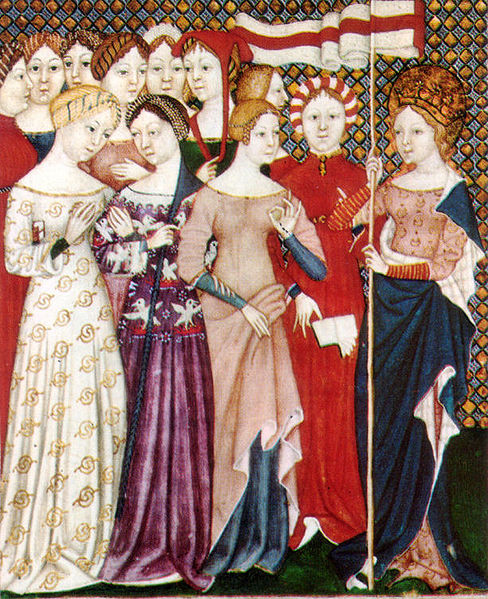
Italian illustration, ladies in silk gowns with a saint, ca.1380
(I love the saint's stripy underdress sleeves :-D)

Belles Heures de Duc du Berry, St. Jerome Tempted by Dancing Girls, 1408-9
I've had to hand some of the softest. finest red wool (bottom left) i've ever beheld - one could mistake it for velvet! I've also had a subtle brocade in off-white/cream (right) and red linen (top left) to spare for lining:

The pattern I've used looks something like this:
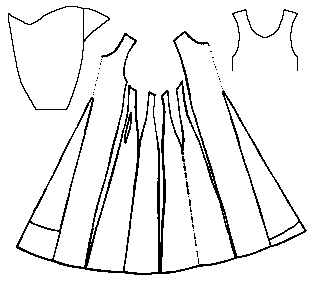
Herjolfsnes no.38 tunic with 8 fitted gores and two center front and back gores
The Herjolfsnes gown has been used frequently by re-enactors as a source for an original pattern. Its survival is one of only a pinch of resources. The 'gores' (aka panels) allow the gown to be adjusted to closely fit the body, thus achieving the tailored finish. The top left image is a rough pattern for the sleeve (the little triangle sits a little higher than the shoulder blade, rather than in the armpit where we normally put a diamond shaped insert for freedom of arm movement).
I plan to fasten it down the front with buttons or lacing and possibly have tippets (arm bands with long, dangly bits at the elbows) in white/cream. The fabric has been all cut and the front half of the wool tacked. With time so tight, i've resorted to sewing it together with my old hand-turn Singer machine, rather than hand stitching the whole lot! I'll wear my red linen underdress with the black and gold sleeves underneath....
Here are a few shots to give you an idea - better ones to come when more tacking comes out and i can model it! ;-) With the nature of its shape, it's impossible to lie completely flat out. My apologies for the strange colours - my camera wouldn't behave tonight under the room light....
Front body: Right hand side of dress has been machine sewn, left hand side to go, hence the more vague seams.The middle-centre seam has been tacked for the moment to allow me to alter the shape appropriately, but it will be released for lacing later.

Skirt spread: I've closely followed the pattern above, but bringing the front seams a little closer to my bust line because of my petite shape.

Subscribe to:
Posts (Atom)